Look, Listen, Repeat
Young students start to build the pre-reading skills necessary to becoming emergent readers. Students begin to connect words to familiar objects and repeat words starting with the same sound.
Enlarge
Reciting Words with Pictures
Students are exposed to rhyming words, phrases, and sentences. Students continue to develop critical pre-reading skills, including phonemic awareness, in preparation for later phonics study.
Enlarge
Letter Sounds
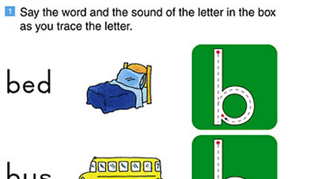
Letter sound exercises help students develop their pre-reading skills by saying individual letter sounds while tracing letters. Students try simple three-letter words and develop their fine motor skills. Students also enjoy very short stories.
Enlarge
Consonant Combinations & Vowel Sounds
Students learn consonant blends, consonant digraphs (such as the /ch/ in cheese), and long vowels with the silent e. Students continue to build their vocabulary and begin to copy letters and words.
Enlarge
Advanced Vowel Sounds & Advanced Sounding Out
Students continue to develop their skill at sounding out words. They will learn to sound out words with a variety of letter combinations while copying letters. They will also say longer compound words by joining two familiar words, as with “snow” and “man” making “snowman”.
Enlarge
Function of Words, Reading Aloud
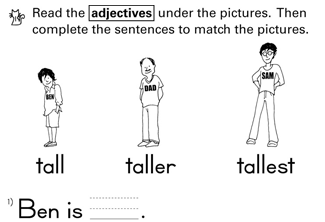
Students identify nouns, verbs, and adjectives, and use them in sentences. Students learn the singular and plural forms of nouns, the fundamentals of verb conjugation, and the comparative and superlative forms of adjectives.
Enlarge
Structure of Simple Sentences
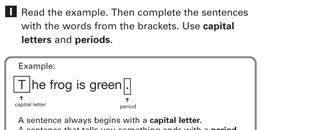
Students are provided a formal introduction to the structure of simple sentences, which includes instruction on capital letters, spaces between words, and basic punctuation. They also learn how to write questions, negative sentences, basic expressions, and sentences in the past tense. By reading stories and answering simple questions, students improve their reading comprehension skills.
Enlarge
Sentence Structure, Sentence Topics, Thought Sequence
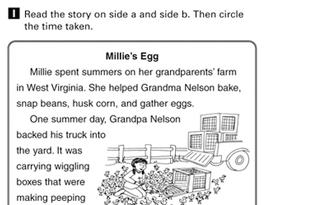
Students complete exercises that improve their ability to read rapidly and accurately while also retaining the information. Mechanical aspects of sentence construction such as punctuation, capitalization, and spelling are also solidified. Students begin developing their ability to recognize a sequence of thoughts presented in a short paragraph. Students also continue to improve their reading comprehension skills by reading short stories and answering text-related questions.
Enlarge
Subject & Predicate
Students refine their ability to identify subject and predicate in longer sentences containing modifiers such as adjectives and adverbs. Students conjugate irregular verbs, as well as study pronouns, prepositions and irregular plurals of nouns.
Enlarge
Comparing & Contrasting
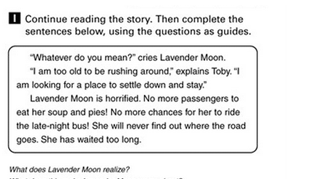
Students focus on reading comprehension and vocabulary building. Students develop their ability to define words using contextual clues in the stories; identify main ideas that occur within a story; and compare and contrast actions, characters, and information from a passage.
Enlarge
Constructing Sentences
Students refine their ability to identify subjects, verbs, and objects in sentences. They also learn how and when to use the future, progressive, and perfect tenses of verbs. Students' punctuation study continues with commas in a series, and singular and plural possessives. Students write complete sentences independently as they read interesting stories.
Enlarge
Organizing Information
Students advance their reading comprehension, vocabulary and writing skills. They develop their ability to construct and respond to questions using who, what, where, when, why, and how; to interpret information in charts; to organize information from passages into chart format; and to write answers independently.
Enlarge
Combining Sentences
Students learn to write compound and complex sentences by combining simple sentences. Students also learn to extract statements from paragraphs to identify a statement as a single unit of thought. Students expand their vocabulary by studying selected words from passages.
Enlarge
Main Idea & Paragraphs
Students continue to build their reading comprehension skills by identifying the topic and then the main idea of the given text. Using their ability to find the main idea of a paragraph, students develop an understanding of how paragraphs flow within a passage. Students also expand their vocabulary by studying selected words from passages.
Enlarge
Clauses
Students learn how clauses can function as nouns, adjectives, or adverbs. In addition, students learn to convert direct speech to indirect speech and vice versa. Charting exercises enable students to visualize information within a passage, which helps to develop their ability to follow and organize content logically. Students also expand their vocabulary by studying selected words from passages.
Enlarge
Reason & Result
Students develop a better understanding of a story's imagery and sequence of events. Charting exercises help the student visualize a story and learn how events in a passage determine a certain result or outcome. Reason and logic exercises build the students’ ability to compose answers and develop skills of rephrasing. Students continue to expand their vocabulary by studying selected words from passages.
Enlarge
Referring Words & Interpreting Text
Students hone their ability to comprehend passages by analyzing referring words; by interpreting text through restatement, examples, and description; and by responding to questions in detail as they construct answers. Students are given greater freedom when composing responses and exercising their sentence writing skills.
Enlarge
Concision, Analysis of & Recounting Events from Paragraphs
Students unravel and acquire an accurate understanding of a text by breaking down complex sentences into simpler statements. Students build the skills necessary to recount a specific scene, action, or description in a story to prepare them for the concision exercises that immediately follow. Students begin to build summarization skills by using basic concision techniques that assist them in condensing information from a text.
Enlarge
Point Making, Theme, & Story Elements
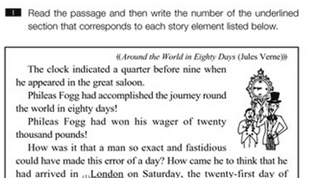
Students read advanced fiction and nonfiction texts and extract the main points, themes, and story elements from passages. They also improve their reading comprehension through summarization exercises.
Enlarge
Summation
Students develop greater sensitivity to an author's use of descriptive language. Summation exercises help students focus on specific points within passages. Students learn to condense all of the important information from a passage into a summary that is about one third the length of the original passage. Students are formally introduced to story elements such as plot, character, and setting. Vocabulary exercises introduce Greek and Latin suffixes, prefixes and roots.
Enlarge
Persuasion
Students analyze the persuasive writing style found in speeches, advertisements, and political documents. They also learn the components and strategies of the more formal "argument." The level concludes with a study of précis, the most complex form of summary.
Enlarge
Critical Reading
Students experience a closer reading of the text than in prior levels with exercises that focus on more subtle details of structure, theme, and character. The reading selections develop students' understanding of how a writer's intentions are reflected in various aspects of the work under review.
Enlarge
Elements of Literature
Students continue to develop critical reading and thinking skills through the study of advanced literature. In the introductory sets of the level, students read non-fiction pieces that present and explain various literary terms such as plot, setting and atmosphere, irony, and comedy. In subsequent sets, students read extracts from novels, plays, or poems that demonstrate these devices put into practice.
Enlarge
Interpretation
Students gain a greater ability to understand the meaning of a text beyond the obvious, common meaning of the vocabulary the author uses. Students are exposed to the basic elements that comprise figurative language and the interpretation of it, making them better able to decipher the plot; the values and standards to which the author may adhere; and the beliefs, intentions, and thoughts of the characters in the story.
Enlarge
Level 7A: Look, Listen, Repeat
Level 6A: Reciting Words with Pictures
Level 5A: Letter Sounds
Level 4A: Consonant Combinations & Vowel Sounds
Level 3A: Advanced Vowel Sounds & Advanced Sounding Out
Level 2A: Function of Words, Reading Aloud
Level AI: Structure of Simple Sentences
Level AII: Sentence Structure, Sentence Topics, Thought Sequence
Level BI: Subject & Predicate
Level BII: Comparing & Contrasting
Level CI: Constructing Sentences
Level CII: Organizing Information
Level DI: Combining Sentences
Level DII: Main Idea & Paragraphs
Level EI: Clauses
Level EII: Reason & Result
Level FI: Referring Words & Interpreting Text
Level FII: Concision, Analysis of & Recounting Events from Paragraphs
Level G: Point Making, Theme, & Story Elements
Level H: Summation
Level I: Persuasion
Level J: Critical Reading
Level K: Elements of Literature
Level L: Interpretation